
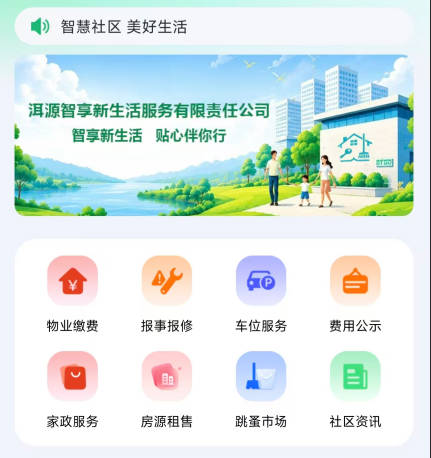
Smart Community Living
Smart Community Living is an integrated community service platform that brings residents' daily errands together with the operations management of property management, real estate agencies, and home services into a single product. It covers five high-frequency categories—payments, repair requests, parking, home finding, and at-home services—so that everything in the community can be started, tracked, and completed.
| Year | 2026 |
|---|---|
| Client | Community Residents and Property Operators |
| Scope | 25–35 pages |
| Tags | Community Services / Mini Program / Operations Backend / Property Digitalization / Local Life |
Project Background
Community life has long been scattered across group chats, paper notices, and back-and-forth errands. Residents have to ask about payments, chase up repair requests, run around to find housing, and rely on luck for home services; property management, agencies, and home service providers each use their own tools, information is not shared, and tasks never reach closure. What Smart Community Living aims to solve is this: let every matter in the community have a starting point, a follow-up, and a conclusion.
Target Users
The resident side serves property owners and tenants; the operations side serves general property management, community administrators, real estate agents, and home service administrators. The backend distributes permissions by role, rather than everyone seeing the same menu.
Product Structure
The resident side has five entries: Home, Property, Listings, Home Services, and Me. The Home page aggregates the most commonly used items of the day—property payments, repair requests, parking spaces, fee disclosures, home services, listings, flea market, and community news. Property is the service desk, supporting identity verification, bill payment, repair tracking, parking space management, fee disclosures, and the neighborhood flea market. Listings support filtering by area, layout, and price, with details, favorites, and viewing appointments. Home services are ordered by service type, with orders moving from pending payment, pending acceptance, pending service, to pending review. "Me" consolidates identity verification, viewing appointments, repair work orders, payment records, favorites, and addresses.
The operations side is separated by role: general property management sees all communities and public affairs, community administrators manage their own community, real estate agents only handle listings and viewing leads, and home service administrators only handle service items, service personnel, and order fulfillment. The workbench displays pending repairs, listing leads, and home service fulfillment by priority.
Core Closed Loop
Take repairs as an example: after a resident verifies their identity and submits a work order, the property management accepts and handles it in the backend, the resident sees the progress, and gives a review upon completion. Payments, viewing appointments, and home service orders reuse the same logic—residents initiate, the corresponding role follows up, and the result returns to the resident's own records.
Design Highlights
Both ends integrated into one, so tasks don't break across systems; backend permissions distributed by responsibility, without stacking menus; a unified closed-loop model of "initiate → follow up → conclude → return to records"; the homepage only shows the most commonly used items of the day, with announcements and unread payment reminders directly exposed.